Pricing
Affordable Healing starts here
Pricing and Services
Lisa is able to offer some flexibility in her hours and occasional Saturday morning clinics are often available.
Acupuncture
Acupuncture (including gua sha, cupping and auricular acupuncture as needed)
First session
First appointment is £70 and lasts up to an hour and a quarter, during which time I cover a history of your lifestyle and medical background plus we you will have your first treatment.
Follow up
Subsequent appointments are charged at £65 and last about 50 minutes.
Coaching and Supervision
Coaching
£50 per 1 hour session.
Supervision
£60 per 1 hour session.
Cancellation Policy
Both your time and mine is precious so I ask that you give as much notice as possible if you are unable to attend your appointment. If there is less than 24 hours notice I will charge full price for this. If you are late attending, I will do my best to give you as best a treatment as possible and I will charge full price for this session.
Insurance
As Lisa is a member of the British Acupuncture Council BAcC, if you have a health insurance policy, it may be possible to claim back all or part of your treatment costs. Please check with your provider prior to the commencement of treatment.
Healthcare providers who insure for Acupuncture as listed by the BACC:




Our Testimonials
Your experience matters
Acupuncture works differently for different people, and as with any medical treatment a cure or complete relief from symptoms can never be guaranteed. However, many people find real benefits from a course of treatment. Here are some examples:
I highly recommend Lisa. Lisa is a great listener and very knowledgeable in her field. She has supported me with multiple close family bereavements and anxiety. Acupuncture has given me incredible results and new ways of coping.
Norma came for acupuncture, at the age of 63, suffering from pain in her upper and lower back as a result of the onset of Osteoporosis. After 4 sessions she started to feel relief from pain.
Sarah came for treatment for swelling of the knees associated with arthritis and knee replacement. Swelling decreased and mobility started to improved.
After a treatment I always feel relaxed and well. My emotions are balanced and my body feels restored and energised - as if every part of me has been reminded how to work properly and in harmony.
You have such powerful skills - I still can't thank you enough for being part of our dream of being parents come true ???
Hi Lisa. Just thought I’d say happy Xmas and send another photo. We have one very chilled out and happy baby, I’m sure in part due to the balancing effects of the acupuncture. She also sleeps through the night! X
FAQs
Have more questions?
Here are answers to some of the most frequently asked questions.
What is your cancelation policy?
Both your time and mine is precious so I ask that you give as much notice as possible if you are unable to attend your appointment. If there is less than 24 hours notice I will charge full price for this. If you are late attending, I will do my best to give you as best a treatment as possible and I will charge full price for this session.
Should I eat and drink before my appointment?
I recommend that you make sure you’ve had your breakfast on the morning of treatment or if your session is in the afternoon you have had lunch and try to be hydrated.
Does acupuncture hurt?
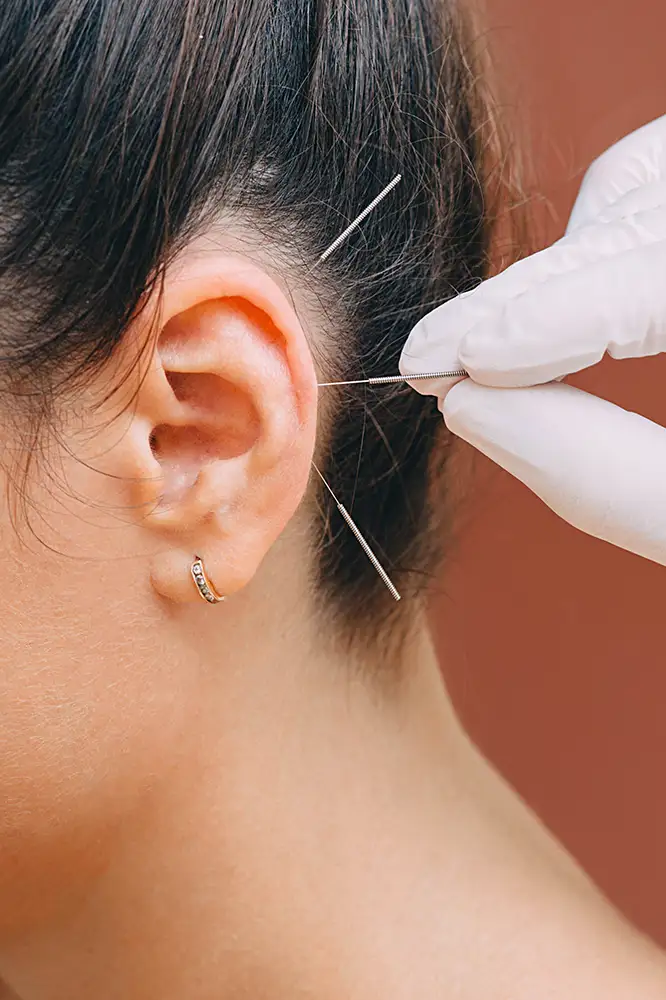
It is normal to feel a mild tingle or dull ache as the acupuncturist adjusts the needle. This sensation is known as deqi. If you do feel in any discomfort please inform your acupuncturist who will able to adjust or remove that particular needle. Acupuncture needles are so fine that many people don’t feel them being inserted. While the needles are in place, many people feel relaxed.
How does acupuncture work?
There are two ways in which this question can be answered. The first is to use the traditional theory of acupuncture to explain how acupuncture works.
It is this theory which a traditional acupuncturist will use to understand your condition and to select the appropriate points. This theory uses the concept of qi. For example, when somebody is in pain, this is considered to be a blockage in flow of qi. A traditional acupuncturist will select points along the meridian that is affected in order to encourage the qi to flow more freely. We are all familiar with a cartoon character that is angry: the head swells and the face goes red. Similarly, if someone is persistently angry, the qi is thought to rise up. An acupuncturist may choose points in the feet to bring the qi down.
The overall aim is to direct the flow of qi to trigger your body’s healing response and to restore physical, emotional and mental equilibrium. Treatment is designed to affect your whole being as well as your symptoms so, as the condition being treated improves, you may notice other health problems resolve and an increased feeling of wellbeing.
The second way to answer the question is to explain how acupuncture works in terms of modern science. One of the first potential mechanisms and probably the most famous is the release of endorphins. However, it is unlikely that the effects of acupuncture can be attributed to a single mechanism. There are a number of possibilities which include [1]:
1. peripheral effects (release of adenosine and nitric oxide by axonal and dorsal root reflexes)
2. spinal effects (modulation of sympathetic tone and motor reflexes)
3. modulation of endogenous descending paying inhibitory and facilitatory systems
4. changing the functional connectivity of the brain. Activation deactivation of
a. limbic structures involved in stress/ illness responses
b. the hypothalamus pituitary adrenal axis
c. the prefrontal and frontal cortices
5. restoration of the default mode state
6. modulation of parasympathetic activity
7. activation of the reward and mirror systems
8. modulation of activation of the immune system
9. expectation, attention, conditioning an extinction of conditioned responses
A landmark study recently published in Nature showed a mechanism that is related to a specific acupuncture but not another. This study demonstrated that vagal-adrenal anti-inflammatory axis in mice was driven by the stimulation of the point ST36 but not ST25 [2]. The importance of this study is that it suggests a specific effect of an
acupuncture point. In other words, the mechanisms of acupuncture are not simply general effects which occur regardless of where the needles are inserted.
1. Lund I, Lundeberg T. Mechanisms of acupuncture. Acupuncture and Related Therapies 2016;4(4):26-30. doi: https://doi.org/10.1016/j.arthe.2016.12.001
2. Liu S, Wang Z, Su Y, et al. A neuroanatomical basis for electroacupuncture to drive the vagal-adrenal axis. Nature 2021;Oct;598(7882)(1476-4687 (Electronic)):641-45. doi: doi: 10.1038/s41586-021-04001-4
Are there any side effects?
As acupuncture involves the insertion of needles there will sometimes be a small bruise where the needle was inserted. Occasionally, people can feel dizzy or tired after a treatment, but this passes quickly.
To help your acupuncturist ensure that there are no unwanted side effects, please let them know any medications that you are taking, such as anti-coagulants. Also let them know if feel hot or the room is stuffy, or you are hungry/thirsty.
Please also see the FAQ: Is acupuncture safe?
Is acupuncture safe?
There have been a number of scientific papers published on the safety of acupuncture. These have concluded that acupuncture is safe so long as it is delivered by a properly trained individual. Therefore, we would recommend that you ensure your acupuncturist belongs to a professional organisation such as the British Acupuncture Council.
As acupuncture involves the insertion of needles there will sometimes be a small bruise where the needle was inserted. Occasionally, people can feel dizzy or tired after a treatment, but this passes quickly.
To help your acupuncturist ensure that there are no unwanted side effects, please let them know any medications that you are taking, such as anti-coagulants. Also let them know if feel hot or the room is stuffy, or you are hungry/thirsty.
Research papers on the safety of acupuncture:
MacPherson H, Thomas K, Walters S, et al. The York acupuncture safety study: prospective survey of 34 000 treatments by traditional acupuncturists. BMJ Clinical research 2001;323(7311):486-87.
White, A. (2006). The safety of acupuncture – evidence from the UK. Acupuncture in Medicine, 24(Suppl), 53–57. https://doi.org/10.1136/aim.24.Suppl.53
Witt CM, Pach D, Brinkhaus B, et al. Safety of acupuncture: results of a prospective observational study with 229,230 patients and introduction of a medical information and consent form. Forschende Komplementärmedizin 2009;16(2):91-97. doi: 10.1159/000209315
What clothes should I wear?
We generally recommend that people wear loose comfortable clothing. This will help you to be relaxed during the treatment and allows easier access to many of the acupuncture points.